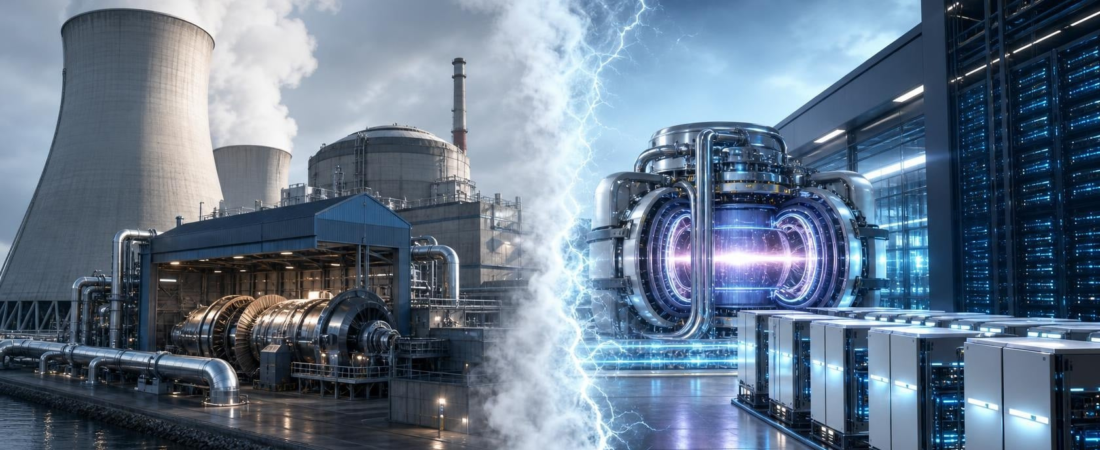
Changing the reactor is only part of the problem. Electricity still has to reach the customer.
Advanced nuclear power may sound completely different from conventional nuclear energy, but it still begins with the same basic product: heat.
Ask someone what a nuclear power plant produces, and the usual answer is electricity.
Technically, that is not what the reactor produces.
Nuclear fission produces heat.
When uranium atoms split, the released energy heats the reactor fuel. A coolant carries that heat away. In most nuclear power plants, the heat is eventually transferred to water, which becomes steam. The steam spins a turbine, and the turbine drives a generator.
Only at that final stage does electricity appear.
The basic sequence is:
Nuclear fission → heat → coolant → steam → turbine → generator → electricity
Even then, the job is not finished. The electricity must pass through transformers, substations, transmission lines, and local distribution systems before it reaches a home, factory, or data center.
That is the central reality of advanced nuclear power: the reactor makes heat, the turbine and generator make electricity, and the grid delivers it.
Much of the Power Industry Still Runs on Steam
Power plants carry very different labels: coal, nuclear, geothermal, concentrated solar, and combined-cycle natural gas.
They do not all work in exactly the same way. Solar panels convert sunlight directly into electricity. Wind and hydroelectric plants turn turbines without boiling water. Combined-cycle gas plants first use hot combustion gases to drive a gas turbine, then use the exhaust heat to produce steam for a second turbine.
But much of the world’s thermal power generation still follows a familiar formula:
Make heat. Boil water. Spin a turbine. Generate electricity.
Charles Parsons built the first practical modern steam turbine in 1884. More than 140 years later, machines descended from that design remain central to electricity production.
Advanced nuclear power has changed much of the front end. The back end often looks surprisingly familiar.
The Coolant Changed. The Turbine Mostly Didn’t.
Many advanced nuclear power developers have moved away from water as the primary reactor coolant.
X-energy’s Xe-100 uses helium gas. Oklo’s Aurora uses liquid sodium. Kairos Power uses a molten fluoride salt called Flibe. These coolants can operate at higher temperatures or lower pressures than the water used in conventional reactors.
Then comes the power-conversion system.
In the Xe-100, helium carries heat from the reactor to a steam generator. The helium and water remain in separate circuits, but heat passes through metal tubing and turns the water into steam at temperatures of up to approximately 565°C.
That steam drives a turbine.
The Xe-100 is designed to produce 200 MW of thermal energy and approximately 80 MW of electricity. The reactor may be advanced, but its electricity is still produced through a familiar steam cycle.
Oklo has followed a similar strategy. In November 2025, the company signed a binding contract with Siemens Energy for an SST-600 condensing steam turbine, an industrial generator, and supporting equipment for its first Aurora powerhouse.
This is intentional. Oklo is combining a new reactor design with commercially established power equipment.
Some future reactors may use gas turbines, supercritical carbon dioxide systems, or other conversion methods. But many advanced reactors closest to deployment are keeping the steam turbine because the equipment is mature, understood, and supported by an established supply chain.
Why Steam Is So Difficult to Replace
Keeping the steam turbine is not a failure of imagination.
Water is inexpensive, nonflammable, widely understood, and well suited to carrying thermal energy. Engineers have more than a century of experience designing steam generators, turbines, condensers, pumps, and pressure systems.
Manufacturers already know how to build and maintain the equipment. Plant operators understand how it behaves. Regulators know how to evaluate it.
For a company already attempting to commercialize a new reactor, proven power-conversion equipment reduces the number of new technologies that must work at the same time.
That is the advantage. It is also the limitation.
Every heat engine faces thermodynamic efficiency limits. Conventional light-water nuclear plants typically convert roughly one-third of their thermal energy into electricity. Higher-temperature advanced reactors may achieve better efficiency, but they must still reject a substantial amount of unused heat.
A steam-cycle nuclear plant may require:
- A steam generator or heat exchanger
- High-pressure piping
- A turbine and generator
- A condenser
- Cooling towers, water cooling, or air-cooled equipment
- Pumps, valves, electrical systems, and large foundations
Not every plant needs a large river or cooling tower. Dry cooling is possible. But every thermal plant must dispose of waste heat somehow.
Making the reactor smaller does not automatically make every supporting system proportionally smaller or cheaper.
SMR developers hope factory manufacturing, repeated designs, and standardized construction will offset some of this loss of scale. Whether those savings will be large enough remains one of the central questions in the SMR economics debate.
Generating Electricity Is Only Half the Job
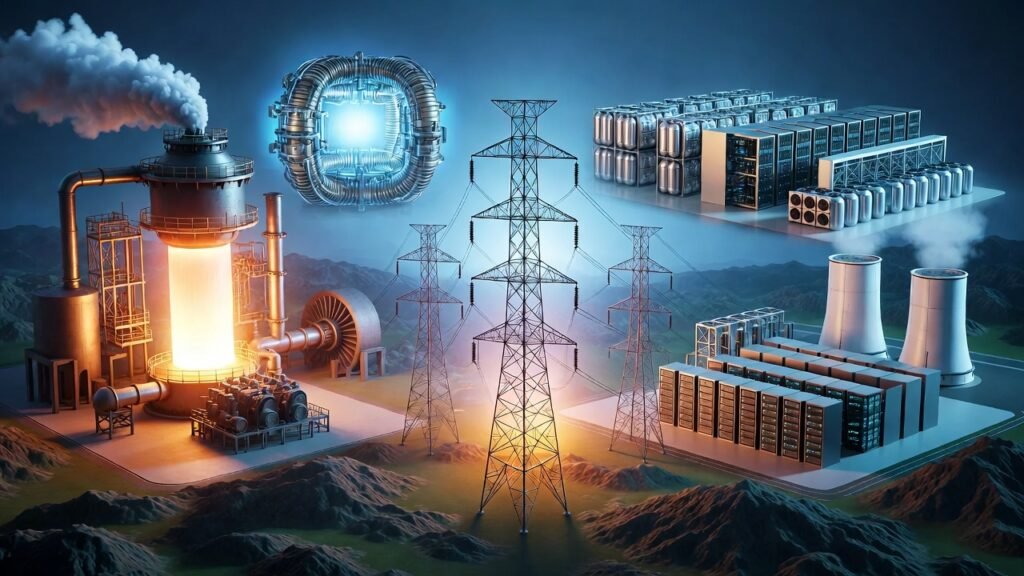
Even a perfectly functioning reactor and turbine are not enough.
Electricity leaving a generator usually cannot be sent directly to customers. It must first pass through a step-up transformer that raises the voltage for efficient long-distance transmission.
From there, the electricity may travel through:
- A plant substation
- High-voltage transmission lines
- Regional switching stations
- Local substations
- Distribution lines
- Neighborhood or facility transformers
Each part requires equipment, land, engineering, permits, construction, and maintenance.
If the existing grid cannot safely accept the additional electricity, the project may have to pay for major upgrades. Those upgrades can include new transmission lines, larger substations, additional transformers, protection systems, and equipment needed to keep voltage and frequency stable.
Transmission construction brings its own difficulties.
Developers may have to acquire rights of way across many privately owned properties. Projects can require environmental reviews, state and local approvals, negotiations with utilities, and public hearings.
Communities may object to new transmission towers or substations. Specialized transformers and high-voltage equipment can also require long manufacturing schedules.
The cost varies enormously by location, distance, terrain, voltage, and the condition of the existing grid. There is no honest single price that applies to every transmission project.
But the time problem is measurable.
Lawrence Berkeley National Laboratory reported in its 2026 interconnection study that U.S. power projects completed in 2025 spent a median of more than five years moving from an interconnection request to commercial operation.
That does not mean every project spent five years physically constructing transmission lines. The figure includes grid studies, agreements, financing, permitting, construction, and testing.
But it shows that connecting a power project can take years even after the generation technology has been selected.
A small reactor therefore does not automatically produce a small total project.
The reactor may be compact, while the plant still needs a turbine, cooling equipment, transformers, substations, grid protection systems, and possibly new transmission capacity.
Locating a reactor at a retired power plant or industrial site may reduce some of those costs because transmission infrastructure already exists. But a completely new site may require far more work than the reactor’s size suggests.
Why AI Data Centers Care About Onsite Power
This grid problem helps explain why AI data centers are looking at onsite generation.
A data center cannot operate while waiting years for sufficient grid capacity. It needs large amounts of dependable electricity, often 24 hours a day.
If power can be generated beside the data center, the developer may avoid or reduce some long-distance transmission construction and interconnection delays.
That is one reason Bloom Energy’s modular fuel cells have attracted interest. The equipment can be transported to a site and installed close to where the electricity will be consumed.
Onsite generation does not eliminate all infrastructure. A large fuel-cell installation still needs natural-gas pipelines or another fuel supply, transformers, switchgear, control systems, backup equipment, and sometimes a grid connection.
But it can shorten the distance between generation and consumption.
For a data center developer, the deciding factor may not be which technology produces the cheapest theoretical electricity. It may be which technology can provide dependable power soon enough for the facility to open.
The Other Path: Skip the Steam Cycle
The more radical approach is not simply to find a better fuel or coolant.
It is to convert energy into electricity without first running a large steam cycle.
Two companies illustrate this idea from different directions.
Helion: Fusion Without a Steam Turbine
Most fusion concepts expect to capture fusion heat, transfer it to a coolant, boil water, and drive a steam turbine.
Helion Energy is attempting something different.
Helion forms two field-reversed configuration plasmas, accelerates them toward one another, and compresses the merged plasma with powerful magnetic fields.
As the heated plasma expands, it pushes back against the magnetic field. Under Faraday’s law, the changing magnetic field induces electrical current in the surrounding coils.
The proposed system directly recovers electrical energy from the plasma instead of sending fusion heat through a steam generator and turbine.
This does not mean the entire plant has no machinery or moving components. Helion still requires magnets, capacitors, vacuum equipment, cooling systems, fuel processing, and extremely fast power electronics.
But removing the large steam turbine from the main conversion chain could reduce the size and complexity of the conventional power island.
On February 13, 2026, Helion announced that its seventh prototype, Polaris, had produced measurable deuterium-tritium fusion and reached plasma temperatures of 150 million°C.
The company described it as the first privately developed fusion machine to demonstrate measurable D-T fusion.
That is a significant milestone, but it is not the same as producing net electricity.
Helion previously said Polaris was expected to demonstrate net electricity in 2024. Its 2026 announcement did not claim that this milestone had been achieved.
The company has also not released a peer-reviewed Polaris paper containing enough information for independent researchers to verify net energy or net electricity performance.
There is another distinction. Helion plans to use deuterium-helium-3 for commercial operation, not the D-T fuel used for its February 2026 test.
D-He-3 requires more demanding plasma conditions and a workable method of producing, recovering, and recycling helium-3.
Helion has begun construction work at the site of its Orion plant in Malaga, Washington. Under its agreement with Microsoft, the company is targeting delivery of at least 50 MW of electricity in 2028.
That date remains a company target, not a demonstrated outcome.
Orion will also need a functioning electrical connection to deliver its power to Microsoft through the regional grid.
Skipping the turbine does not automatically eliminate the need for transformers, substations, transmission access, or grid approval.
Bloom Energy: Turbine-Free Power Already in Use
Bloom Energy’s solid oxide fuel cells provide a commercial example of electricity generation without combustion or a steam turbine.
When operating on natural gas, Bloom’s system internally converts the fuel into a hydrogen-rich gas. The fuel cell then combines that fuel and oxygen electrochemically to produce electricity.
There is no flame driving a turbine.
Because the primary conversion process is electrochemical, emissions of nitrogen oxides, sulfur oxides, and particulate matter are extremely low compared with combustion engines.
Bloom says its Energy Server has an average lifetime electrical efficiency of approximately 54%.
When useful waste heat is captured in a combined heat and power system, combined electrical and thermal efficiency can exceed 90%.
Commercial interest is substantial.
In April 2026, Bloom announced that Oracle had contracted an initial 1.2 GW of fuel-cell capacity under a master agreement supporting purchases of up to 2.8 GW.
In June 2026, Bloom and Brookfield expanded their financing framework for AI power projects from $5 billion to $25 billion.
Those numbers require careful wording. “Up to 2.8 GW” does not mean all 2.8 GW is currently installed. Brookfield’s $25 billion figure is a financing framework, not guaranteed Bloom revenue.
Still, the demand for faster onsite power is real.
The Case Against Turbine-Free Power
Removing the steam turbine does not remove the difficult physics or engineering.
Field-reversed configuration plasmas are known to be vulnerable to instabilities.
Critics, including Helion co-founder and former chief scientist John Slough, have questioned whether Helion’s rapid merging and compression process can maintain magnetic confinement long enough to generate the required energy.
Helion acknowledges that conventional magnetohydrodynamic calculations predict FRC instability.
The company argues that kinetic effects, pulsed operation, and ion behavior can stabilize the plasma under the right conditions.
The disagreement cannot be settled by a company announcement alone. More independently reviewable data will be necessary.
Bloom has a different limitation.
Most Bloom fuel-cell installations today run on natural gas. They avoid combustion-related pollutants and can use fuel efficiently, but they still release carbon dioxide.
Bloom’s systems can operate on hydrogen or hydrogen blends, but low-carbon hydrogen is not currently available at the price and scale required for most data centers.
Hydrogen capability is a possible future pathway. It does not make today’s natural-gas installations carbon-free.
Where I Land
The steam turbine is not obsolete. It remains dominant because it works, is well understood, and is supported by an enormous industrial supply chain.
But the full power-system problem is larger than the turbine.
A new energy technology must do three things:
- Produce usable energy reliably
- Convert that energy into electricity economically
- Deliver the electricity to the customer through adequate infrastructure
Advanced reactors focus heavily on the first step. Helion and Bloom are attempting to simplify the second. AI data centers are forcing the industry to confront the third.
Helion could reach an important electricity milestone before some new U.S. advanced reactors enter commercial service.
That is a narrower and more defensible claim than saying fusion will arrive before SMRs. Small modular reactors are already operating in Russia and China, while Helion has not yet publicly demonstrated net electricity.
Direct conversion may remove major steam equipment, but it does not remove plasma physics, fuel supply, cooling, transformers, substations, or the need to deliver power safely.
Onsite fuel cells may reduce dependence on new transmission, but they still require fuel infrastructure and currently produce carbon emissions when operating on natural gas.
The real energy race is therefore not simply nuclear versus fusion, or fossil fuels versus renewable energy.
It is a race to build the entire chain:
Energy source → electricity conversion → grid connection → delivery to the customer
After more than 140 years, the steam cycle finally has credible challengers.
But whichever technology wins must solve more than the reactor.
It must also solve everything that comes after the generator.
Sources
- International Energy Agency — How Electricity Is Generated
- Science Museum Group — Parsons’ Steam Turbine Generator, 1884
- X-energy — Xe-100 Technical Overview
- Oklo and Siemens Energy Steam Turbine Contract — November 19, 2025
- IAEA — SMR Designs Already in Operation — September 18, 2025
- Lawrence Berkeley National Laboratory — 2026 Interconnection Queue Report
- U.S. Department of Energy — Data Center Electricity Demand Report
- Helion — Direct Electricity Recovery Technology
- Helion — Polaris D-T Fusion Announcement — February 13, 2026
- Helion — Orion Construction and Microsoft Target — July 22, 2025
- Helion’s Earlier Polaris Net-Electricity Target — October 5, 2023
- Scientific American — Helion Technology and Scientific Skepticism — May 19, 2026
- Bloom Energy Server Efficiency and Deployment Data
- Bloom and Oracle Agreement — April 13, 2026
- Bloom and Brookfield Financing Framework — June 30, 2026
This article is for general informational purposes only and is not investment advice. Company targets, project costs, and planned deployment dates may change.