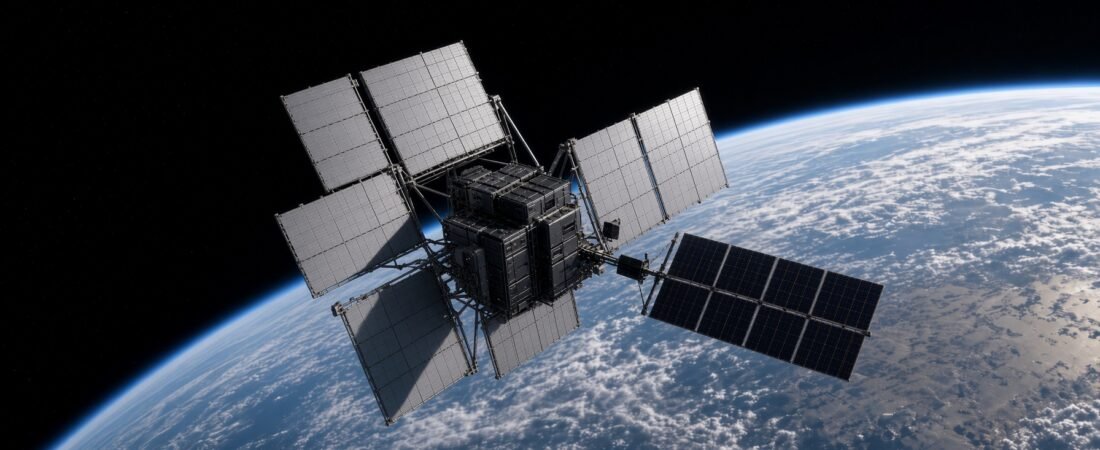
Space is about 455 degrees below zero Fahrenheit (–270°C) — only a few degrees above absolute zero, the coldest anything can possibly get. So at first glance, cooling a computer up there sounds easy. Down here, computers need fans, coolant, pumps, and sometimes enormous cooling systems just to keep from overheating. Put that same machine somewhere colder than anywhere in the universe has any right to be, and surely the heat problem takes care of itself. That’s the intuition almost everyone has about cooling data centers in space, and it’s wrong.
Space is very cold, but that does not mean it is good at cooling things.
The reason is simple. There’s almost nothing there.
Think about a thermos
A thermos keeps coffee hot for hours. The trick is the vacuum layer between its two walls. Heat needs something to travel through, and a vacuum offers almost nothing to work with, so the heat stays where it is.
Space works the same way. It is an enormous vacuum — a thermos the size of everything.
This is where intuition leads people astray. What matters isn’t only how cold the surroundings are. What matters is what can actually carry the heat away. Stand outside on a freezing day and you feel cold because air is constantly stealing your body heat. Take the air away, and there’s nothing left to do the stealing.
On Earth we have three exits. In space, two are bricked up.
Heat moves in three ways.
Conduction is heat moving through direct contact — the handle of a frying pan getting hot. Convection is moving air or liquid carrying heat somewhere else, and it’s the workhorse of nearly every cooling system you’ve ever seen. Computer fans push air. Cars circulate coolant. Data centers move air and chilled water through the building and dump the heat into the atmosphere, burning something like 30 percent of their electricity doing it. Radiation is the third, and it needs no medium at all — it’s why sunlight crosses 93 million miles of empty space to reach us, and why your face feels warm in front of a fireplace before the room does.
In a vacuum, the first two are essentially gone. A fan can spin as fast as it likes; there’s no air to move. So a spacecraft has to gather its internal heat, carry it to radiator panels, and throw it away as infrared light — glowing it off, invisibly.
On Earth we carry heat away. In space we have to send it away.
Why cooling data centers in space is so slow
Radiation works. It’s just slow, and the numbers are startling.
A radiator panel held near room temperature sheds roughly 600 watts per square meter. Water cooling on Earth moves heat more than a thousand times faster. Six hundred watts isn’t nothing — that’s a one-meter panel throwing off as much heat as a space heater. It’s just competing against water, and a factor of a thousand is not a gap you close with a clever material.
Which leaves one lever: make the panel bigger. Here is what that looks like in practice.
| Scale | Radiator area |
|---|---|
| One rack of 32 GPUs (40 kW) | A pickleball court (80 m²) |
| A 1-megawatt orbital facility | A hockey rink (1,600 m²) |
| A 100-megawatt facility | 2,500 pickleball courts |
| Starcloud’s proposed 5-gigawatt design | Three square miles of panel (8 km²) |
Those figures come from an IEEE Spectrum analysis and from Starcloud’s own published estimates. Read the first row again: a pickleball court, unfolded in orbit, to cool 32 chips. On Earth that same job is done by a radiator the size of your forearm and a few liters of water.
Same heat, same chips. Only the stage changed.
The most visually striking part of a future orbital computing facility may not be the computers at all. It may be the enormous panels unfolding around them.
A strange twist: hotter radiators work better
Here’s where the physics gets genuinely interesting. A radiator that runs twice as hot doesn’t shed twice the heat — it sheds about sixteen times as much. The relationship isn’t proportional. It’s explosive.
So run the panels hot and you can make them dramatically smaller. Wonderful — except that the thing we’re cooling is a computer chip, and heat only flows from hot to cold. If the radiator sits at 300°F (150°C), the chip has to be hotter still for heat to move in the right direction. No silicon survives that.
The computer wants to stay cool. The radiator works better hot.
There’s a way around it, and it’s sitting in your window right now. An air conditioner doesn’t shove indoor heat straight outside — it compresses a refrigerant to raise the temperature of that heat first, which is why the air coming off the outdoor unit is hotter than the summer day around it. A spacecraft can do the same: keep the chips at 70°F (20°C), let a compressor lift that heat to 300°F (150°C), and hand it to a much smaller panel.
No free lunch, of course. Compressors draw power, and that power becomes heat too, so the total load goes up. But temperature pays off as a fourth power while the electricity only adds, so in some regimes the trade is worth making. In orbit, where every kilogram is money, you’re essentially burning power to buy area.
Why not just use the back of the solar panels?
This one seems obvious. The spacecraft already carries huge solar arrays. The sunward face is working; the back is idle. Free real estate.
The catch is that the back isn’t cool. Solar cells run around 30 percent efficient, which means roughly 70 percent of the sunlight they absorb turns into heat right there in the panel. Arrays in orbit typically sit somewhere around 140–175°F (60–80°C). The GPU cooling loop, meanwhile, needs to stay near 70–100°F (20–40°C). Heat only flows one way — so wire the two together and it runs backwards, into your servers.
Unused surface area and good radiator area are not the same thing.
Space isn’t as dark as it looks
One more complication: a satellite in low orbit isn’t floating in perfect blackness. Half its sky is Earth.
Sunlight near Earth delivers about 1,361 watts per square meter — more than double what a room-temperature panel can shed. Earth adds its own contribution, reflecting sunlight and glowing in infrared. So which way a radiator faces stops being a detail and becomes part of the cooling system. Orbital radiators typically have to turn edge-on to the Sun, like a knife blade held to the light.
No data-center operator on Earth has ever had to ask which direction the building should face today to keep the GPUs happy.
None of this makes it impossible
It’s worth saying plainly: cooling data centers in space is a hard problem, not an impossible one. Engineers have been managing heat in vacuum for sixty years. Satellites, Apollo, Skylab, the Space Shuttle, the International Space Station — all of them run carefully designed thermal-control systems, and the toolkit is mature. Heat pipes that move fluid by capillary action in zero gravity. Pumped two-phase loops. Surface coatings that reflect sunlight while radiating infrared. Deployable panels that fold for launch and unfold in orbit. The ISS has been shedding its heat through ammonia loops and radiator wings for decades.
This isn’t a new problem. It’s an old problem at a new scale. Cooling a conventional satellite is one thing. Cooling thousands of high-power GPUs running flat out, continuously, is another.
Which is why the conversation about orbital data centers can’t be only about rockets, solar power, and chips. Thermal management belongs in the same sentence.
Change the environment and common sense changes with it
On Earth, when computers run hot, you move more air or circulate more coolant. Cooling is a solvable afterthought — designers worry about performance and power first, heat second.
In orbit that order flips. Before you decide how many chips you can run, you have to answer a more basic question: how much heat can you actually get rid of? Radiator area becomes the ceiling on computing power.
That may be the single biggest difference between a data center on Earth and one in space. Space is astonishingly cold, and it doesn’t help nearly as much as you’d think — because being cold and being good at cooling are not the same thing. Even at 455 below, a computer will happily cook itself if it can’t shed the energy it makes.
So the next time you see a story about AI data centers in orbit, don’t look only at the rocket or the chips. Look at the panels unfolding beside them. Those radiators may say as much about the limits of computing in space as the silicon does.
Figures drawn from IEEE Spectrum (June 2026), the World Economic Forum (June 2026), and the Brookings Institution (June 2026). Radiator area estimates vary considerably between sources depending on design assumptions.