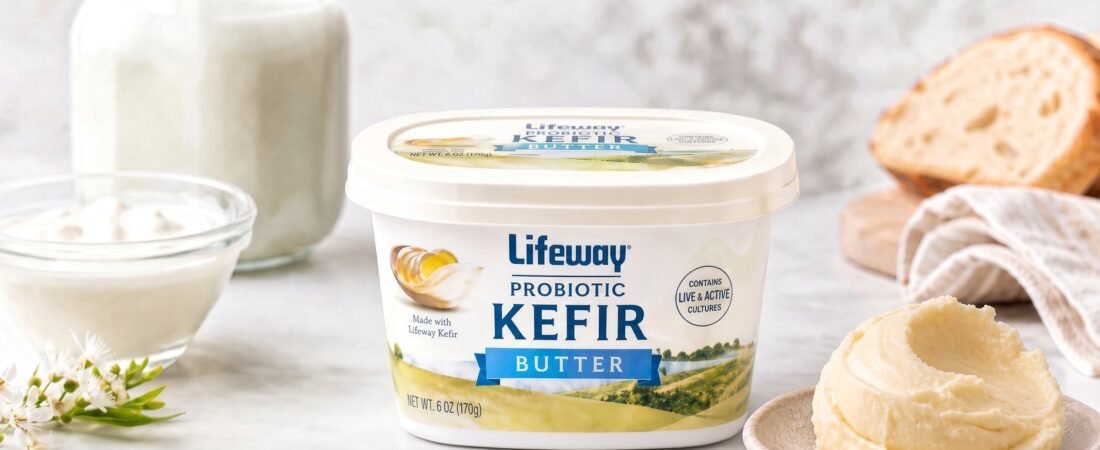
Kefir has spent decades in the refrigerated drinks case. This year it arrived on the butter shelf.
Lifeway Foods (Nasdaq: LWAY), America’s leading supplier of kefir, announced Probiotic Kefir Butter on January 13, 2026. The product is now available at Target, and it is one of twelve finalists for the 2026 Dairy Foods Product of the Year award, competing in the Butters/Creamers category. Public voting runs August 1–31, 2026, with the winner announced in the magazine’s October issue.
If kefir is already part of your routine, this is a natural extension of it. Here is what the product is, how it relates to the kefir you drink, and how to get the most out of it.
A Quick Refresher on Kefir
Kefir is a fermented milk drink, thinner than yogurt and noticeably tangier, with a slight effervescence that comes from the fermentation itself.
Lifeway, founded in 1986, states that its kefir contains 12 live and active probiotic cultures: B. breve, B. lactis, B. longum, L. acidophilus, L. casei, L. cremoris, L. lactis, L. plantarum, L. reuteri, L. rhamnosus, S. diacetylactis, and S. florentinus. According to the company, that is a broader range of strains than most commercially produced yogurt carries.
The nutrition panel for Plain Lowfat Kefir lists 110 calories and 10 grams of protein per 1-cup (240 ml) serving, with no added sugar. Lifeway describes an 8-ounce serving as an excellent source of vitamin D, riboflavin, calcium, and phosphorus, and a good source of protein, vitamin A, vitamin B12, potassium, and selenium. The company also notes that because fermentation consumes much of the milk sugar, its kefir is up to 99 percent lactose free, which is why many people who avoid milk can still drink it comfortably.
One practical shopping note: plain kefir carries no added sugar, while flavored varieties do. A flavored 8-ounce serving can contain 20 grams of sugars. If you drink it daily, plain is the one to reach for, and fruit can go in at home.
Published CFU figures vary across Lifeway’s own materials, from 25–30 billion per serving on several product and retailer listings up to 50 billion on the company’s FAQ page and some product pages. The simplest approach is to read the label on the bottle you actually buy.
What Is in the Kefir Butter
Probiotic Kefir Butter comes in three varieties, each aimed at a different use:
- Unsalted for cooking, baking, and pure butter flavor
- Sea Salt for finishing dishes and savory cooking
- Honey Butter for breakfast, snacking, and sweet applications
Lifeway makes it through its Fresh Made subsidiary, which already operated a butter business before this launch. The ingredient list is short. For the salted version: butter (pasteurized cream, natural flavor), clarified butter (pasteurized cream), kefir (pasteurized whole milk, cultures, vitamin D3), salt, and cultures. The unsalted version is the same minus the salt.
The butterfat content is 82 percent. That is what makes it European-style. Standard American butter must contain at least 80 percent milkfat, and the additional fat gives European-style butter a firmer body, a richer mouthfeel, and better performance in pastry. Both versions are gluten free with no added sugar, and the butter is churned to stay spreadable straight from the tub.
The nutrition differs slightly between the two, so it is worth having both figures. Per tablespoon (14 grams):
| Per 1 tbsp (14 g) | Salted | Unsalted |
|---|---|---|
| Calories | 100 | 100 |
| Total fat | 11 g | 12 g |
| Saturated fat | 8 g | 8 g |
| Cholesterol | 25 mg | 25 mg |
| Sodium | 85 mg | 0 mg |
| Carbohydrates | 0 g | 0 g |
| Protein | 0 g | 0 g |
That is in line with other premium butters at the same butterfat level.
A note on package size: the January 13 launch announcement described an 8-ounce tub, while Lifeway’s current product pages and retail listings show 6 ounces. Use the package in front of you when working out cost per ounce.
Getting the Most From It

The cultures in kefir butter are live, and live cultures are heat-sensitive. That gives a simple rule of thumb for how to use each variety.
For the probiotic element, use it uncooked. Spread it on bread or toast that has cooled slightly, finish steamed vegetables or a cooked steak with a pat at the table, build a butter board, or stir it into a sauce after it comes off the heat. This is where the Sea Salt and Honey Butter varieties do their best work.
For baking and pan cooking, treat it as what it is at that point: an excellent 82 percent butterfat cultured butter. Oven and skillet temperatures are well beyond what live cultures survive, so a batch of biscuits made with kefir butter is not a probiotic food. It is still very good baking butter, and the extra fat and cultured tang are exactly why European-style butter is prized in pastry. The Unsalted variety is the one Lifeway positions for this, and the company publishes a kefir butter biscuit recipe of its own.
Worth knowing: Lifeway publishes a strain list and CFU counts for its drinkable kefir but not for the kefir butter, which is labeled simply as containing billions of live and active probiotics per serving. There is also a structural difference between the two products. Churning butter drains away most of the water-soluble portion of the cream, so a cultured butter and a fermented milk drink are not interchangeable as probiotic sources. The butter is a good addition to a kefir habit rather than a replacement for it.
Why It Arrived Now
The launch lines up with a shift in federal nutrition guidance.
On January 7, 2026, the Department of Health and Human Services and the Department of Agriculture released the 2025–2030 Dietary Guidelines for Americans, presented by HHS Secretary Robert F. Kennedy Jr. alongside a redesigned food pyramid. The guidelines set a target of three servings of dairy per day and endorse full-fat dairy with no added sugars. Their gut health section names fermented foods directly, including sauerkraut, kimchi, kefir, and miso. The full text is available at realfood.gov.
Lifeway welcomed the guidelines in a statement six days before announcing the butter, saying kefir had been recognized for its role in supporting a healthy microbiome.
The market backdrop supports the move as well. Lifeway puts the U.S. butter and butter blends category at roughly $6 billion, with premium and European-style formats driving growth as shoppers trade up for flavor and texture, and with spreadable tub formats gaining share. CEO Julie Smolyansky has described the launch as a response to a changed consumer mindset, pointing to a broad move away from the fat-free thinking of earlier decades. She has also noted that homemade kefir butters appear among the first recipes in her book, The Kefir Cookbook, so the pairing is not new to the company, only newly commercial.
Where to Find It, and What Is Next
Probiotic Kefir Butter is available at Target and rolling out through select retail and foodservice channels through 2026.
Voting for the Dairy Foods 2026 Product of the Year closes on August 31, 2026, with the result published in the October issue. Lifeway’s entry competes in Butters/Creamers alongside Flora Food Group’s Red Barn Creamery Butter, in a field of twelve that also includes entries from Kraft, Bel Brands, Dairy Farmers of America, and Graeter’s, whose Skyline Spice Ice Cream won the inaugural award in 2025.
For a daily kefir drinker, the butter is an easy way to bring the same cultured, tangy character to the rest of the table. Use it cold for the probiotics and hot for the pastry, and it earns its place either way.
This article is for general information and is not medical or nutritional advice. If you have questions about dairy, saturated fat, or probiotics in your own diet, talk with your doctor or a registered dietitian.
Sources: Lifeway Foods product pages and press releases; Dairy Foods; U.S. Dietary Guidelines 2025–2030 (realfood.gov). Product data verified August 29, 2026.