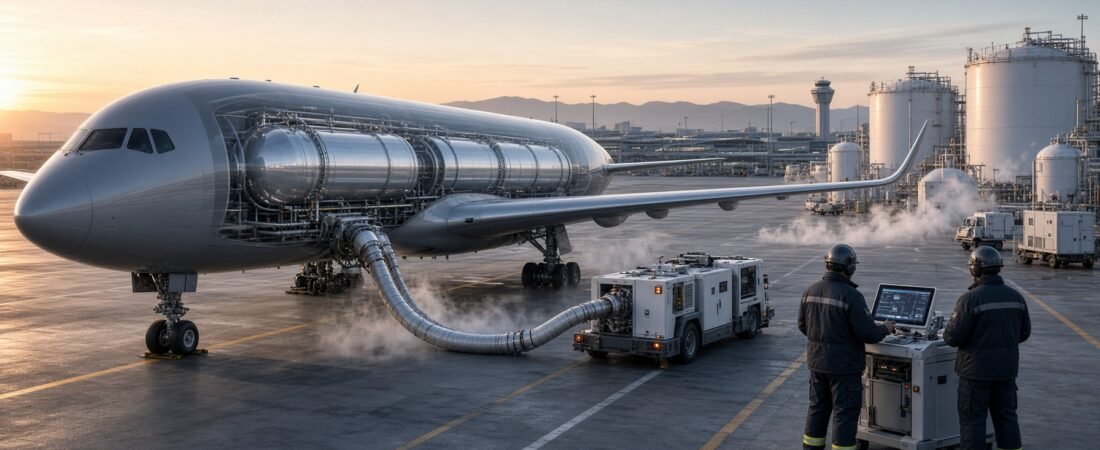
LNG aviation could force the aerospace industry to rethink not only the airplane, but the airport around it.
For more than half a century, commercial aviation has been built around one powerful assumption: airplanes burn liquid hydrocarbon fuel that can be stored inside wings, pumped quickly at airports, and handled by an infrastructure already built around that fuel.
Change that assumption, and almost everything begins to move.
The fuel tanks change.
The fuselage may change.
The fueling equipment changes.
Airport safety systems change.
Maintenance procedures change.
Even the familiar shape of the airplane may no longer be the best answer.
That is what makes NASA’s 2026–2027 Dream with Us “Fueling Flight Design” challenge more interesting than a simple classroom exercise.
The bigger question is not merely:
What fuel should tomorrow’s airplane burn?
It is:
What happens to the entire aviation system when the fuel itself changes?
For engineers studying cryogenic fuels such as liquefied natural gas, or LNG, that question quickly becomes much larger than the engine.
Aviation Was Built Around Jet Fuel
Modern airports are not fuel-neutral transportation hubs.
Their infrastructure evolved around conventional aviation fuels such as Jet A.
Jet fuel remains liquid at ordinary temperatures. It can be stored in conventional tanks, moved through pipelines and fueling trucks, and placed inside aircraft wings without the extreme thermal-management systems required by cryogenic fuels.
That convenience has influenced aircraft design for decades.
The wings of a conventional airliner do more than generate lift.
They can also function as enormous fuel-storage structures.
That arrangement is remarkably efficient.
Fuel weight is distributed close to the aircraft’s lifting surfaces, while valuable passenger and cargo space inside the fuselage remains available.
LNG changes that relationship.
LNG Must Be Kept Extremely Cold
Liquefied natural gas is mostly methane that has been cooled until it becomes a liquid.
At atmospheric pressure, LNG is maintained at approximately −162°C, or −260°F. The U.S. Department of Energy notes that liquefaction reduces natural gas to roughly 1/600 of its gaseous volume, making large-scale storage and transportation practical. The Department of Energy’s Energy.gov
For aviation, however, that extreme temperature creates an entirely new engineering problem.
Imagine an aircraft sitting on an airport ramp during a hot summer day.
Outside temperatures might exceed 30°C.
Inside the fuel tank, LNG must remain near −162°C.
The temperature difference can approach 200°C.
Heat constantly wants to move into that tank.
That means insulation is no longer optional.
It becomes part of the aircraft’s fundamental architecture.
NASA has studied cryogenic aircraft fuel systems involving both liquid methane/LNG and liquid hydrogen, including the consequences for tanks, propulsion systems and aircraft integration. NASA Technical Reports Server
You Cannot Simply Pour LNG Into a Jet-Fuel Tank
This is where the problem becomes physically interesting.
Traditional aircraft often use parts of the wing itself as an integral fuel tank.
Cryogenic LNG cannot simply be placed into that same structure without major changes.
A practical LNG tank would require:
- substantial thermal insulation,
- cryogenic-compatible materials,
- specialized fuel lines,
- pumps and valves designed for very low temperatures,
- pressure-management systems,
- leak detection,
- and systems to manage vapor formation.
NASA studies of LNG aircraft propulsion have described dedicated storage tanks, fuel distribution systems and cryogenic pumps as necessary parts of such an architecture. NASA Technical Reports Server
That raises one of the most difficult questions in alternative-fuel aircraft design:
Where Do You Put the Fuel?
Aircraft engineers like wing tanks for a reason.
They use space efficiently and place fuel relatively close to the center of lift.
Cryogenic tanks are different.
Pressure vessels and heavily insulated tanks generally favor rounded, cylindrical or spherical geometries rather than the thin internal volume of a conventional wing.
That can push designers toward placing large fuel tanks inside or behind the passenger fuselage.
Now the consequences start multiplying.
A large tank may reduce passenger capacity.
It may reduce cargo space.
It may lengthen the fuselage.
It may require structural reinforcement.
And as fuel is consumed during flight, engineers must carefully manage changes in aircraft balance and center of gravity.
At that point, the fuel tank is no longer just another component.
The fuel tank begins to shape the airplane.
[여기에 3번 LNG 기체 구조 이미지 삽입]
Conceptual illustration showing how cryogenic LNG storage could affect aircraft fuselage, tank placement and structural design.
A New Fuel Could Produce a New Aircraft Shape
That leads to an even more interesting possibility.
Instead of asking:
How do we fit LNG into today’s airplane?
engineers may eventually ask:
Why should tomorrow’s airplane look like today’s airplane at all?
Conventional tube-and-wing aircraft have been refined for decades around conventional fuel, engines and airport infrastructure.
Bulky cryogenic tanks could make other configurations more attractive.
One possibility is a blended-wing-body aircraft, in which the fuselage and wing merge into a much broader lifting structure.
Such configurations can create more internal volume than a narrow cylindrical fuselage.
That extra volume could potentially help accommodate large fuel tanks, cargo or other energy-storage systems.
The point is not that LNG guarantees a blended-wing future.
It does not.
The important point is that changing fuel can reopen aircraft-design decisions that once seemed settled.
Then the Problem Moves to the Airport
Suppose engineers successfully design an LNG-powered aircraft.
The next problem is waiting on the ground.
How do you refuel it?
Today’s major airports are vast fuel-distribution networks.
Jet fuel arrives through terminals, pipelines, storage farms and trucks before eventually reaching aircraft.
LNG would require a parallel cryogenic system.
An airport supporting LNG aircraft could need specialized:
- insulated storage tanks,
- cryogenic transfer lines,
- pumps,
- fueling vehicles,
- pressure-control equipment,
- gas detectors,
- emergency venting systems,
- fire-protection procedures,
- maintenance facilities,
- and staff training.
Suddenly, the airport is no longer simply an airport.
It becomes a multi-energy industrial facility.
And the complexity grows even further if several propulsion technologies coexist.
Future airports could potentially need to handle conventional Jet A, sustainable aviation fuel, electricity, hydrogen and other fuels at the same time.
That is a far larger infrastructure challenge than replacing one fuel truck with another.
The Hidden Enemy Is Heat
Cryogenic aviation also introduces a problem passengers rarely think about:
boil-off.
No insulation system is perfect.
Some heat inevitably enters a cryogenic tank.
As that happens, a portion of the liquid fuel can vaporize.
Gas occupies much more volume than liquid, so vapor formation can raise tank pressure.
Engineers then need a strategy.
Can the vapor be sent to the engine?
Can it be reliquefied?
Can tank pressure be controlled without wasting fuel?
What happens when the aircraft sits unused for hours?
NASA has investigated LNG boil-off and long-duration cryogenic storage, noting that even high-performance insulation cannot completely eliminate heat entering a cryogenic tank without additional cooling. NASA Technical Reports Server
This means an LNG aircraft would not simply carry fuel.
It would carry a continuously managed thermal system.
That changes the economics of ground operations as well as the engineering of flight.
Hydrogen Makes the Same Problem Even Harder
LNG is not the only cryogenic fuel under consideration in aerospace.
Liquid hydrogen presents an even more extreme thermal challenge.
The U.S. Department of Energy lists liquid hydrogen storage at approximately −253°C, or −423°F, compared with approximately −162°C for LNG. The Department of Energy’s Energy.gov
NASA research identifies boil-off and tank insulation as major challenges for liquid-hydrogen aircraft concepts. NASA Technical Reports Server
That makes LNG technically interesting even if it never becomes a dominant commercial aviation fuel.
Many of the engineering questions overlap:
How do you build lightweight cryogenic tanks?
How do you minimize heat leakage?
How do you transfer fuel safely?
How do you manage pressure?
How does the tank change the aircraft structure?
How does an airport handle cryogenic fuel efficiently?
Those questions matter far beyond LNG alone.
Why Consider LNG at All?
Cryogenic fuels introduce major complications, so why investigate them?
One reason is that aviation has an unusually difficult energy problem.
Aircraft must carry their own energy source.
Every extra kilogram affects payload, range and efficiency.
Batteries have made major progress, but long-distance commercial aviation places very demanding limits on energy storage by mass.
Chemical fuels remain attractive because they contain large amounts of energy relative to their weight.
LNG also burns differently from conventional kerosene-based aviation fuels.
But LNG should not automatically be described as “green aviation.”
Natural gas is still a fossil fuel.
Methane leakage during production, transportation and storage can also significantly affect lifecycle greenhouse-gas emissions.
So the real engineering value of LNG aviation may not be that it represents a final climate solution.
Its importance may lie in what it forces engineers to learn.
The Aircraft Is Only Half the System
This is where NASA’s challenge becomes more important than its title may suggest.
People tend to imagine aviation innovation as something attached to an airplane.
A new engine.
A strange wing.
A futuristic cockpit.
But energy systems extend far beyond the aircraft.
A new fuel may require changes to:
the airplane,
the airport,
the fueling network,
maintenance facilities,
emergency systems,
regulations,
supply chains,
and even airline scheduling.
A fuel that performs beautifully inside an engine could still fail commercially if storing and delivering it becomes too expensive or operationally difficult.
That is the systems-engineering lesson hiding behind the technology.
The Real Revolution May Be on the Ground
When people picture the future of flight, they usually look toward the sky.
But some of aviation’s most consequential changes may happen at ground level.
Behind airport fences could appear cryogenic tanks, insulated pipelines, new fueling vehicles, advanced sensors and entirely new safety systems.
Inside future aircraft, fuel storage could become a major structural feature instead of something hidden quietly inside the wings.
And that could ultimately change what airplanes look like.
LNG may or may not become a major commercial aviation fuel.
That question remains open.
But the engineering problem it exposes is already important.
For decades, aviation optimized airplanes around one dominant energy system.
Now engineers are beginning to ask what happens when that assumption no longer holds.
And once the fuel changes, the airplane may have to change with it.
LNG aviation could force the aerospace industry to rethink not only the airplane, but the airport around it.
For more than half a century, commercial aviation has been built around one powerful assumption: airplanes burn liquid hydrocarbon fuel that can be stored inside wings, pumped quickly at airports, and handled by an infrastructure already built around that fuel.
Change that assumption, and almost everything begins to move.
The fuel tanks change.
The fuselage may change.
The fueling equipment changes.
Airport safety systems change.
Maintenance procedures change.
Even the familiar shape of the airplane may no longer be the best answer.
That is what makes NASA’s 2026–2027 Dream with Us “Fueling Flight Design” challenge more interesting than a simple classroom exercise.
The bigger question is not merely:
What fuel should tomorrow’s airplane burn?
It is:
What happens to the entire aviation system when the fuel itself changes?
For engineers studying cryogenic fuels such as liquefied natural gas, or LNG, that question quickly becomes much larger than the engine.
Aviation Was Built Around Jet Fuel
Modern airports are not fuel-neutral transportation hubs.
Their infrastructure evolved around conventional aviation fuels such as Jet A.
Jet fuel remains liquid at ordinary temperatures. It can be stored in conventional tanks, moved through pipelines and fueling trucks, and placed inside aircraft wings without the extreme thermal-management systems required by cryogenic fuels.
That convenience has influenced aircraft design for decades.
The wings of a conventional airliner do more than generate lift.
They can also function as enormous fuel-storage structures.
That arrangement is remarkably efficient.
Fuel weight is distributed close to the aircraft’s lifting surfaces, while valuable passenger and cargo space inside the fuselage remains available.
LNG changes that relationship.
LNG Must Be Kept Extremely Cold
Liquefied natural gas is mostly methane that has been cooled until it becomes a liquid.
At atmospheric pressure, LNG is maintained at approximately −162°C, or −260°F. The U.S. Department of Energy notes that liquefaction reduces natural gas to roughly 1/600 of its gaseous volume, making large-scale storage and transportation practical. The Department of Energy’s Energy.gov
For aviation, however, that extreme temperature creates an entirely new engineering problem.
Imagine an aircraft sitting on an airport ramp during a hot summer day.
Outside temperatures might exceed 30°C.
Inside the fuel tank, LNG must remain near −162°C.
The temperature difference can approach 200°C.
Heat constantly wants to move into that tank.
That means insulation is no longer optional.
It becomes part of the aircraft’s fundamental architecture.
NASA has studied cryogenic aircraft fuel systems involving both liquid methane/LNG and liquid hydrogen, including the consequences for tanks, propulsion systems and aircraft integration. NASA Technical Reports Server
You Cannot Simply Pour LNG Into a Jet-Fuel Tank
This is where the problem becomes physically interesting.
Traditional aircraft often use parts of the wing itself as an integral fuel tank.
Cryogenic LNG cannot simply be placed into that same structure without major changes.
A practical LNG tank would require:
- substantial thermal insulation,
- cryogenic-compatible materials,
- specialized fuel lines,
- pumps and valves designed for very low temperatures,
- pressure-management systems,
- leak detection,
- and systems to manage vapor formation.
NASA studies of LNG aircraft propulsion have described dedicated storage tanks, fuel distribution systems and cryogenic pumps as necessary parts of such an architecture. NASA Technical Reports Server
That raises one of the most difficult questions in alternative-fuel aircraft design:
Where Do You Put the Fuel?
Aircraft engineers like wing tanks for a reason.
They use space efficiently and place fuel relatively close to the center of lift.
Cryogenic tanks are different.
Pressure vessels and heavily insulated tanks generally favor rounded, cylindrical or spherical geometries rather than the thin internal volume of a conventional wing.
That can push designers toward placing large fuel tanks inside or behind the passenger fuselage.
Now the consequences start multiplying.
A large tank may reduce passenger capacity.
It may reduce cargo space.
It may lengthen the fuselage.
It may require structural reinforcement.
And as fuel is consumed during flight, engineers must carefully manage changes in aircraft balance and center of gravity.
At that point, the fuel tank is no longer just another component.
The fuel tank begins to shape the airplane.
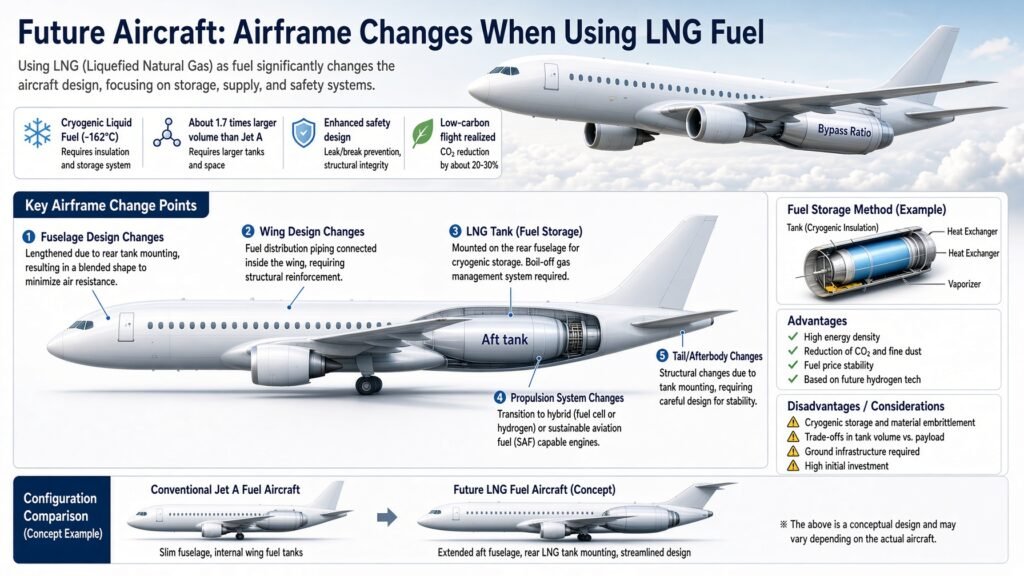
Conceptual illustration showing how cryogenic LNG storage could affect aircraft fuselage, tank placement and structural design.
A New Fuel Could Produce a New Aircraft Shape
That leads to an even more interesting possibility.
Instead of asking:
How do we fit LNG into today’s airplane?
engineers may eventually ask:
Why should tomorrow’s airplane look like today’s airplane at all?
Conventional tube-and-wing aircraft have been refined for decades around conventional fuel, engines and airport infrastructure.
Bulky cryogenic tanks could make other configurations more attractive.
One possibility is a blended-wing-body aircraft, in which the fuselage and wing merge into a much broader lifting structure.
Such configurations can create more internal volume than a narrow cylindrical fuselage.
That extra volume could potentially help accommodate large fuel tanks, cargo or other energy-storage systems.
The point is not that LNG guarantees a blended-wing future.
It does not.
The important point is that changing fuel can reopen aircraft-design decisions that once seemed settled.
Then the Problem Moves to the Airport
Suppose engineers successfully design an LNG-powered aircraft.
The next problem is waiting on the ground.
How do you refuel it?
Today’s major airports are vast fuel-distribution networks.
Jet fuel arrives through terminals, pipelines, storage farms and trucks before eventually reaching aircraft.
LNG would require a parallel cryogenic system.
An airport supporting LNG aircraft could need specialized:
- insulated storage tanks,
- cryogenic transfer lines,
- pumps,
- fueling vehicles,
- pressure-control equipment,
- gas detectors,
- emergency venting systems,
- fire-protection procedures,
- maintenance facilities,
- and staff training.
Suddenly, the airport is no longer simply an airport.
It becomes a multi-energy industrial facility.
And the complexity grows even further if several propulsion technologies coexist.
Future airports could potentially need to handle conventional Jet A, sustainable aviation fuel, electricity, hydrogen and other fuels at the same time.
That is a far larger infrastructure challenge than replacing one fuel truck with another.
The Hidden Enemy Is Heat
Cryogenic aviation also introduces a problem passengers rarely think about:
boil-off.
No insulation system is perfect.
Some heat inevitably enters a cryogenic tank.
As that happens, a portion of the liquid fuel can vaporize.
Gas occupies much more volume than liquid, so vapor formation can raise tank pressure.
Engineers then need a strategy.
Can the vapor be sent to the engine?
Can it be reliquefied?
Can tank pressure be controlled without wasting fuel?
What happens when the aircraft sits unused for hours?
NASA has investigated LNG boil-off and long-duration cryogenic storage, noting that even high-performance insulation cannot completely eliminate heat entering a cryogenic tank without additional cooling. NASA Technical Reports Server
This means an LNG aircraft would not simply carry fuel.
It would carry a continuously managed thermal system.
That changes the economics of ground operations as well as the engineering of flight.
Hydrogen Makes the Same Problem Even Harder
LNG is not the only cryogenic fuel under consideration in aerospace.
Liquid hydrogen presents an even more extreme thermal challenge.
The U.S. Department of Energy lists liquid hydrogen storage at approximately −253°C, or −423°F, compared with approximately −162°C for LNG. The Department of Energy’s Energy.gov
NASA research identifies boil-off and tank insulation as major challenges for liquid-hydrogen aircraft concepts. NASA Technical Reports Server
That makes LNG technically interesting even if it never becomes a dominant commercial aviation fuel.
Many of the engineering questions overlap:
How do you build lightweight cryogenic tanks?
How do you minimize heat leakage?
How do you transfer fuel safely?
How do you manage pressure?
How does the tank change the aircraft structure?
How does an airport handle cryogenic fuel efficiently?
Those questions matter far beyond LNG alone.
Why Consider LNG at All?
Cryogenic fuels introduce major complications, so why investigate them?
One reason is that aviation has an unusually difficult energy problem.
Aircraft must carry their own energy source.
Every extra kilogram affects payload, range and efficiency.
Batteries have made major progress, but long-distance commercial aviation places very demanding limits on energy storage by mass.
Chemical fuels remain attractive because they contain large amounts of energy relative to their weight.
LNG also burns differently from conventional kerosene-based aviation fuels.
But LNG should not automatically be described as “green aviation.”
Natural gas is still a fossil fuel.
Methane leakage during production, transportation and storage can also significantly affect lifecycle greenhouse-gas emissions.
So the real engineering value of LNG aviation may not be that it represents a final climate solution.
Its importance may lie in what it forces engineers to learn.
The Aircraft Is Only Half the System
This is where NASA’s challenge becomes more important than its title may suggest.
People tend to imagine aviation innovation as something attached to an airplane.
A new engine.
A strange wing.
A futuristic cockpit.
But energy systems extend far beyond the aircraft.
A new fuel may require changes to:
the airplane,
the airport,
the fueling network,
maintenance facilities,
emergency systems,
regulations,
supply chains,
and even airline scheduling.
A fuel that performs beautifully inside an engine could still fail commercially if storing and delivering it becomes too expensive or operationally difficult.
That is the systems-engineering lesson hiding behind the technology.
The Real Revolution May Be on the Ground
When people picture the future of flight, they usually look toward the sky.
But some of aviation’s most consequential changes may happen at ground level.
Behind airport fences could appear cryogenic tanks, insulated pipelines, new fueling vehicles, advanced sensors and entirely new safety systems.
Inside future aircraft, fuel storage could become a major structural feature instead of something hidden quietly inside the wings.
And that could ultimately change what airplanes look like.
LNG may or may not become a major commercial aviation fuel.
That question remains open.
But the engineering problem it exposes is already important.
For decades, aviation optimized airplanes around one dominant energy system.
Now engineers are beginning to ask what happens when that assumption no longer holds.
And once the fuel changes, the airplane may have to change with it.
The airport may have to change too.