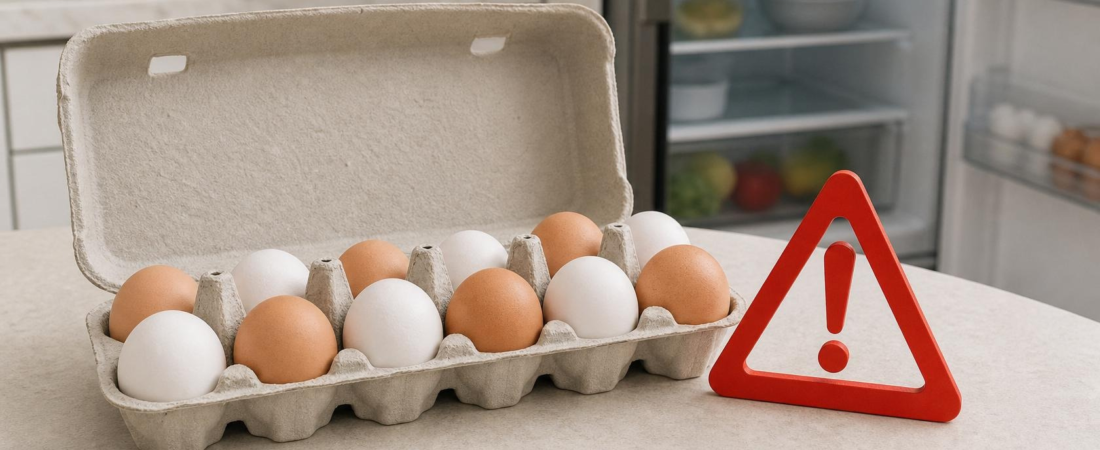
The egg recall 2026 investigation is expanding as the U.S. Food and Drug Administration and the Centers for Disease Control and Prevention investigate a multistate Salmonella outbreak linked in part to recalled shell eggs.
As of July 24, 2026, 98 illnesses have been reported across 17 states. Twenty-six people have been hospitalized, and no deaths have been reported. The investigation remains ongoing.
Consumers are being advised to check egg cartons carefully and avoid eating, selling, or serving any products included in the recall.
Which Eggs Were Recalled?
Midwest Poultry Services, L.P. recalled white shell eggs and brown cage-free shell eggs produced at farms in Texas between June 6 and July 3, 2026.
The affected eggs were sold in packages containing 6, 12, 18, 24, 30, 36, or 60 eggs under the following brand names:
- Kroger
- Simple Truth
- Brookshire’s
- Country Morning
- Cal-Maine Sunups
The recalled cartons have sell-by or best-by dates between July 20 and August 17, 2026.
Consumers should also look for the identifying codes P-1950 or 0840962, sometimes printed as 840962, along with a Julian date between 157 and 184. These numbers may appear on either side of the carton.
Where Were the Recalled Eggs Sold?
The recalled eggs were shipped to retail and food-service customers in Texas, Oklahoma, and Louisiana.
They were also available through Kroger stores in Texas and Louisiana, Brookshire Grocery stores in Texas, Oklahoma, Arkansas, and Louisiana, and smaller outlets in those states as well as Mississippi and New Mexico.
The FDA notes that the products may have reached additional locations.
Illnesses have been reported in 17 states, including New York. However, this does not mean that recalled eggs were confirmed for sale in every state where a patient was reported. Investigators are still working to determine whether other sources contributed to the outbreak.
How Was the Outbreak Identified?
Health officials used interviews, laboratory testing, and product tracking to investigate the outbreak. Among 44 patients who provided detailed food information, 40 reported eating eggs before becoming ill.
Testing conducted on samples collected from farms in Texas found Salmonella. Genetic analysis showed that bacteria in some of those samples matched the strain found in people affected by the outbreak.
Midwest Poultry Services was identified as a common egg supplier. However, investigators say the company’s eggs do not account for every illness reported in the outbreak. The FDA and CDC are continuing to investigate whether other food sources may also be involved.
Because the investigation is still active, the number of cases, affected locations, and recall details could change. Consumers should continue checking FDA recall updates, particularly if they recently purchased eggs from one of the listed brands.
What Are the Symptoms of Salmonella?
Salmonella symptoms usually begin 12 to 72 hours after eating contaminated food and often last four to seven days.
Common symptoms include:
- Diarrhea
- Fever
- Abdominal cramps
Children younger than five, adults aged 65 and older, and people with weakened immune systems have a greater risk of developing a severe infection.
Some people may recover without specific treatment, but severe diarrhea can lead to dehydration. Anyone experiencing serious or persistent symptoms after eating eggs should report them to a healthcare provider.
What Should Consumers Do?
Check the brand, identifying code, Julian date, and sell-by or best-by date on egg cartons in your refrigerator.
If your eggs match the recall information, do not eat them. Throw them away or return them to the store for a refund. If the original carton is missing and you cannot determine whether the eggs are included, the FDA recommends discarding them.
Clean and sanitize refrigerator shelves, containers, countertops, and other surfaces that may have touched the recalled eggs. Wash hands, utensils, and surfaces with hot, soapy water before and after handling raw eggs.
Do not rely on appearance or smell to determine whether eggs are contaminated. Salmonella usually does not produce visible changes that consumers can recognize.
The FDA investigation is continuing, and the recall information may be updated as additional details become available.