Introduction
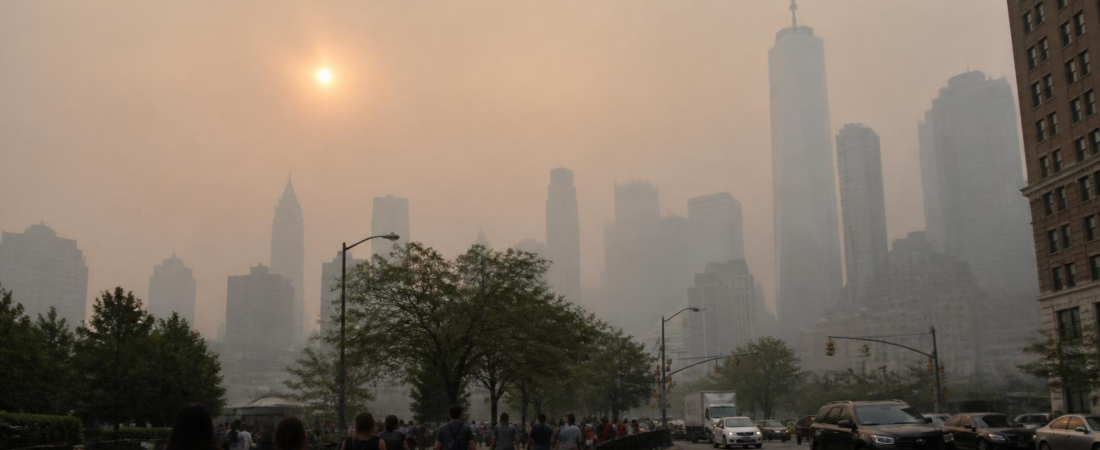
Canadian wildfire smoke in New York created unusually hazy skies in mid-July 2026. On July 16, many residents across New York City, Long Island, and surrounding communities noticed reduced visibility, a dimmer sun, and the smell of burning wood in the air.
The previous day, the New York State Department of Environmental Conservation and Department of Health issued a statewide Air Quality Health Advisory because smoke from wildfires in Canada was affecting the region. The advisory warned about elevated levels of fine particulate matter, also known as PM2.5.
Although the wildfires were burning hundreds of miles away, changing wind patterns carried smoke into New York and other parts of the northeastern United States.
Air Quality Advisory Issued Across New York
The statewide advisory issued on July 15 included Long Island, the New York City metropolitan area, the Lower and Upper Hudson Valley, the Adirondacks, and several other regions.
Long Island and the New York City metropolitan area were forecast to experience air quality that was unhealthy for sensitive groups. Some other parts of New York were forecast to reach the unhealthy category.
New York officials issue an Air Quality Health Advisory when pollution levels are expected to rise above an Air Quality Index, or AQI, value of 100. Higher AQI values indicate greater potential health concerns.
Air quality can change quickly as smoke moves with the wind. Conditions may differ between nearby communities and may improve or worsen during different hours of the day. Residents should therefore check current local readings instead of relying only on what the sky looks like.
What Is PM2.5?
Wildfire smoke contains a mixture of gases and microscopic particles. One of the main pollutants of concern is PM2.5, which refers to particles measuring 2.5 micrometers or less in diameter.
These particles are much smaller than a grain of sand and can travel deep into the lungs when inhaled. PM2.5 can come from wildfires, vehicle exhaust, power plants, and other forms of combustion.
Visible haze and the smell of smoke may provide warning signs, but pollution can still be present even when the air does not look extremely smoky. Checking the AQI is a more reliable way to understand current conditions.
What Residents May Notice
During a wildfire smoke event, residents may experience:
- Hazy or smoky skies
- Reduced visibility
- The smell of burning wood
- A dim, red, or orange-colored sun
- Eye, nose, or throat irritation
- Coughing or sneezing
- Headaches or unusual fatigue
- Shortness of breath during outdoor activity
Symptoms can vary depending on the amount of smoke, the length of exposure, a person’s activity level, and existing health conditions.
How Canadian Wildfire Smoke in New York Affects Health
Short-term exposure to elevated PM2.5 levels may cause irritation of the eyes, nose, and throat. It may also contribute to coughing, a runny nose, chest discomfort, or shortness of breath.
Wildfire smoke can aggravate asthma, heart disease, chronic obstructive pulmonary disease, and other respiratory or cardiovascular conditions.
People who may be particularly sensitive include:
- Children and teenagers
- Adults aged 65 and older
- Pregnant people
- People with asthma, heart disease, or lung disease
- People who exercise or work outdoors
- Anyone experiencing an active respiratory illness
People in sensitive groups should follow advice from their healthcare provider and pay close attention to local air-quality reports.
How to Protect Yourself During Wildfire Smoke
When Canadian wildfire smoke in New York causes unhealthy air, residents can take several practical steps to reduce exposure:
- Reduce prolonged or strenuous outdoor activity.
- Move exercise indoors when air quality is poor.
- Keep windows and doors closed when smoke is noticeable.
- Use a portable air cleaner with a HEPA filter when available.
- Set central heating or air-conditioning systems to recirculate indoor air.
- Avoid smoking, burning candles, or using fireplaces indoors.
- Limit activities that create additional indoor particles, including heavy frying.
- Keep necessary medications readily available.
- Follow local health and emergency announcements.
A properly fitted N95 or KN95 respirator may help reduce exposure to fine particles when a person must remain outside. Cloth masks and loose-fitting face coverings do not provide the same level of particle filtration.
People without air conditioning should not remain in a dangerously hot home simply to keep the windows closed. A library, community center, shopping center, or another air-conditioned public building may provide a safer temporary location.
How to Check the Air Quality Index
Residents can check current conditions through AirNow.gov or the New York State Department of Environmental Conservation’s air-quality forecast.
The AQI categories are generally interpreted as follows:
- 0–50: Good
- 51–100: Moderate
- 101–150: Unhealthy for sensitive groups
- 151–200: Unhealthy
- 201–300: Very unhealthy
- Above 300: Hazardous
Because wildfire smoke can shift rapidly, check the AQI before exercising, working outdoors, traveling, or planning activities for children and older adults.
When to Seek Medical Help
Move indoors and reduce activity if smoke exposure causes coughing, eye or throat irritation, headache, or difficulty breathing.
Contact a healthcare professional if symptoms persist or worsen. Seek urgent medical care for severe breathing difficulty, chest pain, fainting, confusion, blue or gray lips, or another serious or rapidly worsening symptom.
People with asthma or another chronic condition should follow their prescribed treatment plan. Do not stop or change medication without consulting a qualified healthcare professional.
Why Wildfire Smoke Can Travel So Far
Smoke can rise high into the atmosphere and travel hundreds or even thousands of miles. Large weather systems and upper-level winds can carry smoke far from the original fire.
As the wind changes, smoke may move into a region for several hours and then clear before returning later. This helps explain why air quality can vary significantly from one day—or even one neighborhood—to another.
Conclusion
Canadian wildfire smoke in New York caused hazy skies and raised air-quality concerns across New York City, Long Island, and other parts of the state in July 2026.
The event demonstrated that distant wildfires can still affect local health and visibility. Residents can protect themselves by checking the AQI, reducing strenuous outdoor activity when pollution is elevated, keeping indoor air cleaner, and paying attention to symptoms.
Sources
- New York State Department of Environmental Conservation: Statewide Air Quality Health Advisory
https://dec.ny.gov/news/press-releases/2026/7/statewide-air-quality-health-advisory - New York State Department of Health: Exposure to Smoke from Fires
https://www.health.ny.gov/environmental/outdoors/air/smoke_from_fire.htm - AirNow: Current Air Quality Information
https://www.airnow.gov/