The Hubble Space Telescope was launched with a flawed mirror. Its images came back blurry, and the mistake became a national embarrassment.
Then astronauts flew up and fixed it. They visited five times in total, replacing cameras, gyroscopes, and solar panels. Hubble is still working today, more than 36 years after launch, largely because people could reach it.
The James Webb Space Telescope cannot be reached. Neither can the Nancy Grace Roman Space Telescope, which launched last weekend. Both were sent to a spot about a million miles from Earth. If something breaks, that is the end of the mission.
NASA chose that anyway. Here is why.
Where Webb and Roman Actually Went
Hubble orbits about 300 miles up — close enough that the Space Shuttle could rendezvous with it. Webb and Roman went roughly 3,000 times farther, to a location astronomers call the second Lagrange point, or L2.
L2 sits on the straight line running from the Sun through the Earth, on the night side, about 1.5 million kilometers (932,000 miles) beyond us.
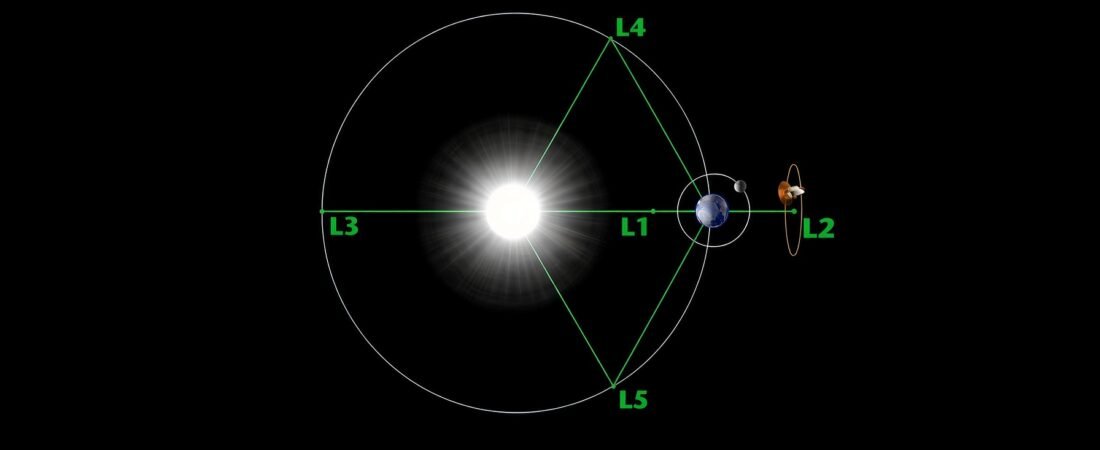
There are five of these points in the Sun–Earth system, and this NASA diagram shows all of them at once.
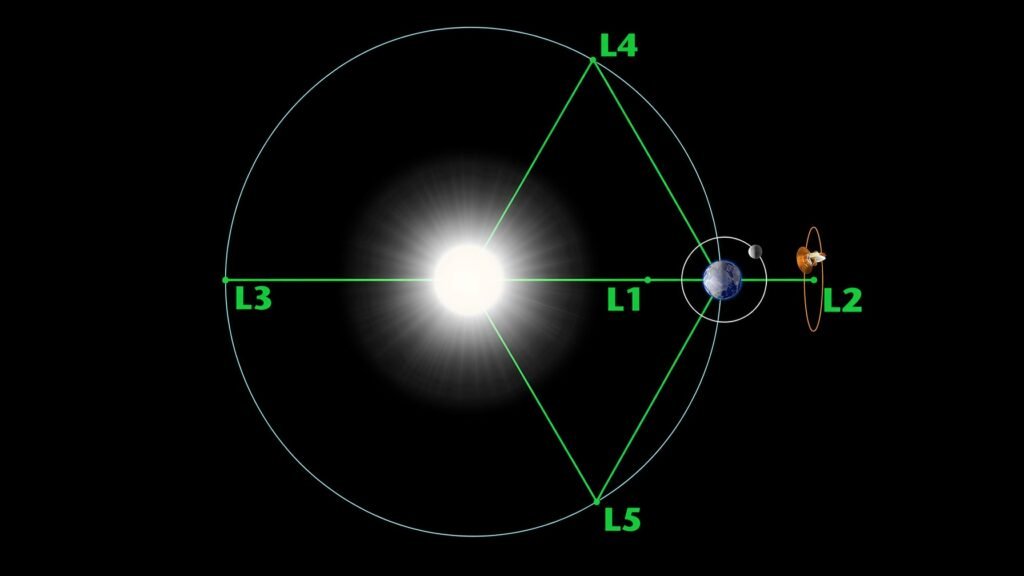
A few things to notice. L1 and L2 sit on either side of Earth along the Sun–Earth line, the same distance out in opposite directions. L3 hides on the far side of the Sun, permanently out of view. L4 and L5 sit on Earth’s own orbital path, one running 60 degrees ahead of us and one trailing 60 degrees behind.
One warning about the picture: the distances are not to scale. In reality, L1 and L2 are only about 1% as far from Earth as the Sun is. On a true-scale drawing they would be crowded right up against the Earth, which is why nobody draws it that way.
What Makes These Points Special
Normally, the farther an object orbits from the Sun, the slower it moves. Mars takes almost two years to circle the Sun; Earth takes one. An object drifting out past Earth’s orbit would fall behind us and be left in the dust.
At L2, that does not happen — and the reason is the Earth.
Out there, the Sun’s gravity and the Earth’s gravity both pull in the same direction, toward the Sun. Added together, they demand a faster orbit than the Sun’s pull alone would. The numbers work out so that a spacecraft at L2 completes one lap in exactly one year, matching Earth’s pace.
The result is a spacecraft that keeps station with Earth permanently, without engines, without effort. It is not a place where gravity cancels out. It is a place where gravity happens to give you the exact speed you need.
The Italian-French mathematician Joseph-Louis Lagrange worked this out in 1772, in a prize-winning paper on the three-body problem. Nobody had anything to put there for another two centuries.
Why an Infrared Telescope Needs to Be There
The obvious question is what you actually gain. Distance is expensive, dangerous, and irreversible.
You gain cold.
Webb and Roman both see in infrared light. Infrared light is heat. That creates a peculiar problem: a warm telescope is blinded by its own glow, the way you cannot photograph a candle from inside a furnace. To see faint heat from distant galaxies, the instrument has to be colder than the thing it is looking at.
That is where the geometry of L2 pays off. Because a spacecraft there stays locked in line with Earth, the Sun, the Earth, and the Moon all sit in the same direction — behind it — all the time. One shield, pointed one way, blocks all three heat sources at once. On the far side of that shield, temperatures fall to a few tens of degrees above absolute zero.
Try that in low Earth orbit and you fail. Hubble circles the planet every 95 minutes, swinging in and out of sunlight, with a warm Earth filling half its sky. There is no fixed direction to point a shield.
There is a bonus, too. From L2, the sky is not blocked by Earth. A telescope can stare at the same patch for as long as it likes. Hubble loses its target every time the planet gets in the way.
Spacecraft Circle L2 Rather Than Sit on It
This is where the diagram is slightly misleading, and where most explanations skip a step.
Spacecraft do not park at L2. They fly a wide loop around it — a path called a halo orbit, hundreds of thousands of kilometers across.
There are practical reasons. Sit exactly at L2 and you are directly behind Earth, in its shadow: no sunlight for the solar panels, and wild temperature swings each time you cross in and out. You are also on a perfectly straight line between Earth and the Sun, which is an awkward place to be for radio communication. Circling wide of the point avoids both problems.
It also explains how Webb, Euclid, and now Roman can share the same region without any risk of collision. They travel on separate loops.
Two of the Five Points Hold Things in Place. Three Do Not.
Here is the part that changes how you read the diagram.
NASA describes the difference with an image worth borrowing. An object at L1, L2, or L3 behaves like a ball balanced on top of a hill. Nudge it, and it keeps rolling away. An object at L4 or L5 behaves like a ball in a bowl. Nudge it, and it settles back.
So Webb and Roman are not parked. They are balanced. Every few weeks, engineers fire small thrusters to nudge them back into place. When the fuel runs out, the telescope drifts off, and the mission is over regardless of how healthy the hardware is.
That is the real cost of choosing L2 — not the distance itself, but the fact that the clock starts running at launch and cannot be reset by a repair crew.
L4 and L5 are a different story. They are stable over billions of years, which means they collect things. Asteroids that wander in tend to stay. Jupiter’s L4 and L5 hold more than 10,000 known asteroids, called Trojans. Earth has a couple of its own, both at L4: one found in 2011, another in 2020. Nothing has turned up at Earth’s L5 yet.
Who Lives Where, Right Now
L1 — the Sun-facing point, and the busiest address in the system. Spacecraft here watch the Sun continuously and see solar storms before those storms reach us. Wind and ACE have been on duty for decades. Three new arrivals joined them this year: NASA’s IMAP settled into L1 orbit on January 10, along with the Carruthers Geocorona Observatory, and NOAA’s space weather satellite followed on January 23, since renamed SOLAR-1.
L2 — the astronomy address. Webb has been working here since 2022, joined by Europe’s Euclid and the Russian-German Spektr-RG. Roman arrives around December. Earlier residents, now retired, include WMAP, Planck, and Herschel.
L3 — behind the Sun, permanently hidden from Earth. Nothing has ever been sent there. Communication would have to route around the Sun, and there is no compelling science to justify the trouble.
L4 and L5 — no spacecraft at either, though the European Space Agency plans to put a solar-monitoring mission at L5, where it could watch storm regions on the Sun rotate toward Earth before they arrive.
What NASA Gave Up
L2 buys darkness, cold, and an uninterrupted view, and pays for it in fuel and finality.
Hubble got fixed because it was close. Webb and Roman will never be fixed, because they had to be far. The images they send back are the argument that the trade was worth making.
Sources
- NASA, “What are Lagrange Points?” — https://science.nasa.gov/solar-system/resources/faq/what-are-lagrange-points/
- NASA, “About Hubble” — https://science.nasa.gov/mission/hubble/overview/about-hubble/
- NOAA NESDIS, “Lagrange Points: An Orbital Parking Spot for Satellites” — https://www.nesdis.noaa.gov/our-satellites/lagrange-points-orbital-parking-spot-satellites
- NASA, “NASA’s IMAP Mission Reaches Its Destination,” January 12, 2026 — https://science.nasa.gov/blogs/imap/2026/01/12/nasas-imap-mission-reaches-its-destination/
- NOAA NESDIS, SOLAR-1 press kit — https://nesdis.noaa.gov/our-satellites/future-programs/swfo/swfo-l1-press-kit
- Space.com, “Lagrange Points: Parking Places in Space” — https://www.space.com/30302-lagrange-points.html