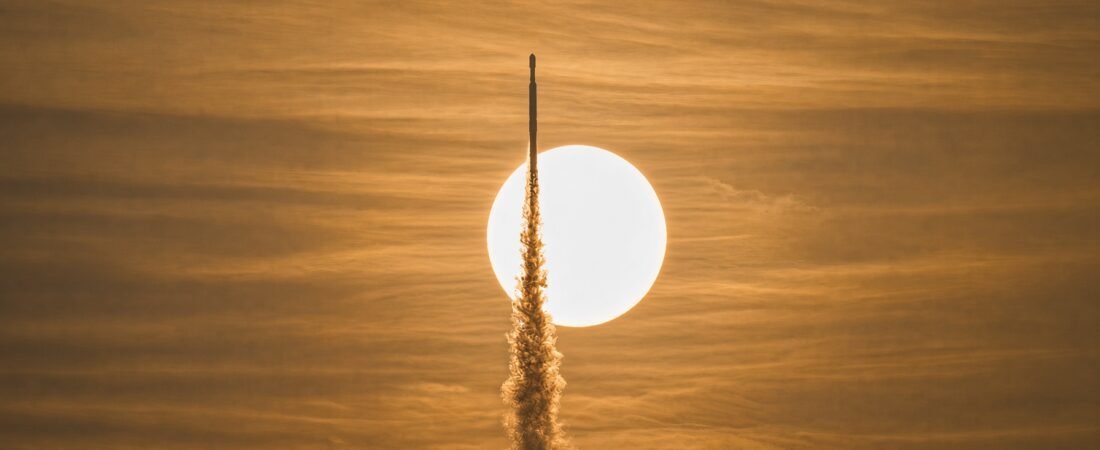
At 7:26 a.m. on Sunday morning, a SpaceX Falcon Heavy rocket lifted off from Florida’s Kennedy Space Center and passed straight across the face of the rising Sun. A NASA photographer caught it — a black rocket against a burning orange disk.
Inside was a telescope that three different federal budget proposals had tried to cancel outright. A fourth tried to cut its money in half while the finished telescope was sitting in a clean room, waiting for a ride.
It launched about nine months early instead, and is now three months from its parking spot a million miles from Earth.
The Nancy Grace Roman Space Telescope is not a replacement for the James Webb Space Telescope, and it is not competing with it. It was built to do a completely different job — and the difference is easier to understand than it sounds.
Why the Roman Space Telescope’s Smaller Mirror Is Not a Weakness
Roman’s main mirror is 2.4 meters wide — about eight feet. That is the same size as Hubble’s mirror and much smaller than Webb’s, which is more than twice as wide.
By the usual scoreboard, bigger mirror means better telescope. So Roman looks like a step down.
But mirror size only tells you how much light a telescope can gather. It says nothing about how much sky it can see at once. And that is where Roman is extraordinary.
Behind that mirror is a camera with about 300 million pixels. In one shot, Roman photographs an area of sky roughly 100 times bigger than Hubble can capture — at the same level of detail. NASA’s own comparison: Roman can survey the sky about 1,000 times faster than Hubble.
Think of it this way. Webb is a zoom lens. It points at one small spot and pulls out an astonishing amount of detail — the air around a single distant planet, a galaxy that formed when the universe was young.
Roman is a wide-angle lens. It photographs huge sweeps of sky over and over, counting millions of objects and spotting patterns you would never notice one picture at a time.
They are not rivals. Roman finds the interesting things; Webb goes back and studies them closely.
There is one more advantage to a wide view. Things happen in space that only last a short while — stars exploding, neutron stars crashing into each other. A telescope looking through a keyhole almost never catches them by chance. Until now, space telescopes usually had to wait for ground telescopes to call and say where to look. Roman can find these events itself.
Its Mirror Was Built to Spy on Earth
Here is the strange part of Roman’s history.
In 2012, the National Reconnaissance Office — the U.S. agency that runs spy satellites — handed NASA some telescope hardware it no longer needed. The mirrors had been made to point down at the Earth, not out at the stars.
NASA did not just bolt a spy satellite onto a rocket. Engineers spent years reworking the optics and building an entirely new observatory around them: new cameras, new electronics, new spacecraft.
But it was still an enormous head start. Grinding and polishing a mirror that size is one of the slowest, hardest parts of building a space telescope, and NASA got one already finished.
Equipment built to watch Earth is now pointed at galaxies billions of light-years away.
Question One: Why Is the Universe Speeding Up?
The universe is expanding. That has been known for a century. What shocked astronomers in the 1990s is that the expansion is getting faster, not slower — as if something is pushing everything apart.
Nobody knows what that something is. Scientists call it “dark energy,” but the name is a label for our ignorance, not an explanation.
There are a few possibilities. Dark energy might be a permanent property of empty space itself. It might be something whose strength has changed over billions of years. Or our understanding of gravity might simply be wrong at the largest scales.
Telling these apart requires measuring the universe at many different distances — which means measuring an enormous number of objects. That is exactly what a wide-angle telescope is for.
Roman will measure more than a billion galaxies and map how they are spread through space. It will also track a particular type of exploding star that always blows up at nearly the same brightness. Because astronomers know how bright those explosions really are, they can tell how far away one is simply from how dim it looks — like judging distance by how faint a streetlight appears. Roman should catch thousands of them, spread across billions of years of history.
Question Two: Where Is the Invisible Matter?
Most of the matter in the universe cannot be seen. It gives off no light, blocks no light, reflects no light. We only know it is there because of its gravity.
Gravity bends light. When light from a faraway galaxy passes near a heavy object, its path curves slightly — so the galaxy appears in a slightly distorted shape, like something seen through old window glass.
Roman will measure the shapes of hundreds of millions of galaxies very precisely. Individually, each distortion is tiny and meaningless. Added together, they reveal where the invisible mass sits.
The result will not be a photograph of dark matter. It will be a map drawn entirely from its gravitational fingerprints.
Question Three: How Many Planets Are Out There?
Roman will run one of the biggest planet hunts ever attempted, using two methods.
The first is the clever one. When one star drifts in front of another as seen from Earth, the near star’s gravity bends and focuses the far star’s light, making it briefly appear brighter. If a planet is circling that near star, it adds its own small extra flicker to the brightening.
NASA expects Roman to find more than 1,000 planets this way. What makes the method valuable is that it finds planets nothing else can: worlds orbiting far out from their stars, and rogue planets — planets drifting through the galaxy with no star at all. A rogue planet gives off almost no light and has no star to pass in front of. The only way to notice one is to catch it bending someone else’s light for a few hours.
The second method comes almost free. To watch for those flickers, Roman has to monitor hundreds of millions of stars constantly. Along the way it will also see stars dim slightly whenever a planet crosses in front of them. NASA estimates that could turn up as many as 100,000 more planets.
Roman also carries an instrument that blocks a star’s glare so nearby planets become visible — a test run for technology future telescopes will need. NASA says it aims to photograph planets and dust disks up to a thousand times fainter, compared with their stars, than other observatories can manage.
Roman is not looking for aliens. It is taking a census: what kinds of planetary systems exist, and how common each kind is.
Washington Tried to Kill It Three Times, Then Tried Again
Roman used to have a duller name: WFIRST, the Wide Field Infrared Survey Telescope.
Every ten years, American astronomers get together and rank what should be built next. In 2010, this project came out first among all proposed large space telescopes.
That did not save it. The White House budget requests for 2019, 2020, and 2021 each proposed shutting the project down and giving it nothing. Congress said no all three times and put the money back.
The fourth attempt came last year. This one did not formally cancel Roman — it asked for $156.6 million, a fraction of what the project had been receiving, as part of a plan to cut NASA’s science budget roughly in half and end dozens of missions.
Congress refused again. The budget that actually passed gave NASA about $24.4 billion, including $300 million to finish Roman — roughly double what the White House had asked for.
The distinction matters. A budget request is a proposal. Congress decides what actually gets spent. Roman survived because lawmakers kept refusing to go along.
You can read that two ways.
The hopeful reading: the system worked. An expensive project got scrutinized repeatedly and kept its funding anyway.
The less comfortable reading: it worked because Congress had to rescue the same project by hand, four times.
And Roman had unusual advantages in that fight. It was the field’s top-ranked project. Its hardware was nearly finished. It had a launch date coming. Cancelling it would have meant throwing away most of $4.3 billion already spent. Projects earlier in development have none of those defenses — nothing built, nothing scheduled, nothing to point at.
What Happens Now
The Roman Space Telescope is three months from L2, a stable point about a million miles from Earth where Webb also operates. Engineers will spend the trip switching on the instruments and calibrating them. NASA expects to release the first images in early 2027.
The main mission runs five years, and the hardware should last longer if the money holds out.
But the thing Roman leaves behind probably will not be one famous photograph. It will be an archive: more than a billion galaxies, hundreds of millions of stars, and possibly over 100,000 planets, all free for anyone to search.
Students in school today may still be finding things in it in the 2040s — objects nobody noticed the first time.
Hubble gave us individual masterpieces. Webb sees deeper than anything before it.
The Roman Space Telescope is here to draw the map
Sources
Mission and science
- NASA launch announcement, August 30, 2026 — https://www.nasa.gov/news-release/nasas-dark-universe-seeking-nancy-grace-roman-space-telescope-launches/
- NASA, “9 Things to Know About NASA’s Nancy Grace Roman Space Telescope” — https://science.nasa.gov/missions/roman-space-telescope/9-things-to-know-about-nasas-nancy-grace-roman-space-telescope/
- NASA, “Roman and Webb” — https://science.nasa.gov/roman-and-webb/
- NASA Roman exoplanet program — https://science.nasa.gov/mission/roman-space-telescope/exoplanets/
Budget figures
- American Astronomical Society, “Congress Passes Fiscal Year 2026 Spending Bills for NSF, NASA, and DOE” — https://aas.org/posts/news/2026/01/congress-passes-fiscal-year-2026-spending-bills-nsf-nasa-and-doe
- Sky & Telescope, “NASA’s Budget Woes Are Over, For Now” — https://skyandtelescope.org/astronomy-news/nasas-budget-woes-are-over-for-now/