Introduction
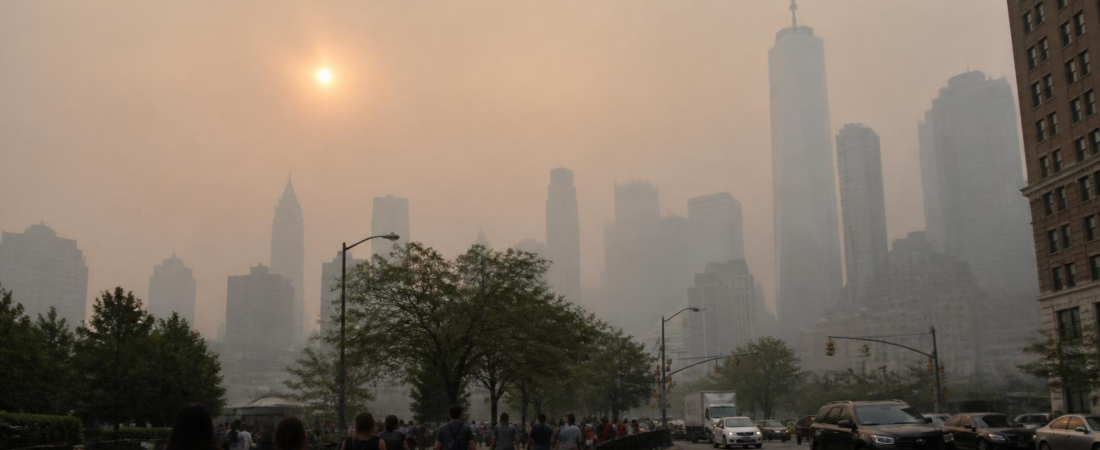
New Yorkers woke up to unusually hazy skies on July 16, with many residents noticing reduced visibility and the smell of smoke in the air.
According to New York State officials, smoke drifting from ongoing wildfires in Canada has moved into the region, affecting air quality across New York City, Long Island, and surrounding counties.
Air Quality Alert Issued Across New York
The New York State Department of Environmental Conservation issued an Air Quality Health Advisory covering New York City, Long Island, and nearby counties.
The advisory warns that fine particulate matter (PM2.5) has reached levels that may be unhealthy, especially for children, older adults, and people with asthma, heart disease, or other respiratory conditions.
Unhealthy Air Quality Reported
Air quality maps showed unhealthy conditions across parts of Long Island during the day.
Near Garden City, the Air Quality Index (AQI) reached 193, placing it in the ‘Unhealthy’ category under the U.S. Air Quality Index.
At this level, prolonged outdoor activity may increase health risks for both sensitive groups and some healthy individuals.
What Residents Experienced
• Hazy or smoky skies
• Reduced visibility
• The smell of burning wood
• A dim or orange-colored sun
• Eye and throat irritation
• Difficulty breathing during outdoor activities
How to Stay Safe
• Limit strenuous outdoor exercise.
• Keep windows and doors closed if smoke is noticeable.
• Use indoor air filtration when available.
• Wear a properly fitted N95 or KN95 mask if spending extended time outdoors.
• Follow local air quality updates until conditions improve.
Why Can Smoke Travel So Far?
Wildfire smoke contains tiny PM2.5 particles that can rise high into the atmosphere and travel hundreds or even thousands of miles with changing wind patterns. Although the fires are burning in Canada, the smoke can still significantly affect air quality in cities across the northeastern United States.
Conclusion
The hazy conditions seen across New York on July 16 were mainly caused by smoke from Canadian wildfires, prompting an official Air Quality Health Advisory. Residents are encouraged to monitor local air quality reports and reduce outdoor exposure while unhealthy conditions continue.